21 Century Business
Herald
January 30, 2008
Jie Gan
The
At the height of the market, when the
It is true that strong earnings growth has been the engine driving this bull run. However, the market seems to have placed too much confidence on the extent to which Chinese company earnings can support today’s market valuation. There are two obvious, but often ignored, points.
First, companies need to reinvest in order to grow. More importantly, for growth to add value, the capital reinvested has to generate a return over and above its cost. Indeed, to generate last year’s spectacular growth, Chinese firms on average reinvested 300% of their earnings in 2006, although the median reinvestment rate was 120% (the big gap between the average and the median is due to “outliers” – those few firms with a very large investment rate – meaning the median is more reliable).
Firms need to raise additional funds to finance this kind of reinvestment. Unless you are a bank which can invest using 100% borrowed money, a typical firm has to issue more equity, which means existing shareholders won’t own all future growth!
In the first two quarters of 2007, the “median” firm
reinvested two-thirds of its earnings (whereas the “average” came out at 200%
of earnings). To put this number into perspective, consider a
Such a market valuation means that, with a reasonable assumption of 15-20% cost of capital,[1] Chinese firms need to generate about 22-30% return on all the reinvestments they are making to support the current valuation.
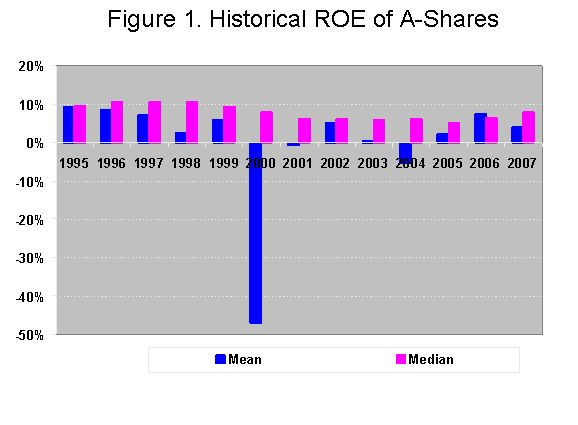
Is 30% reachable? A useful benchmark is the return on existing capital (ROE). Figure 1 plots the historical ROE of Chinese firms. As you can see, during the entire history of the A share market, ROE rarely even reached the 10% level. This year, despite spectacular earnings growth, the average was merely 4% and the median was 8%, in stark contrast to the 22-30% return expected by the market.
A second concern is at the individual stock level. Here, the market cannot tell the difference between good and bad companies. Consider the quality of earnings and their growth. In the first two quarters of 2007, close to one-third of total corporate profits came from investment income, derived from holding other companies’ shares.
Eight per cent of those who reported investment income derived all their earnings from investment come. Guess what their market valuation was? An average PE of 330! Much much higher than the market average. The market often praises these firms as holding “a hen that lays golden eggs.” But it looks like that hen becomes more valuable if it is placed in money-losing companies.
My favorite example is Jilin Aodong, a pharmaceutical
company from north-east
Look a little closer at the numbers, and you start to wonder whether the market knows how to add or subtract. GDS recorded earnings of 1.2 billion yuan in 2006 and, with a PE of 40 – at the high end for securities companies – is worth 60 billion yuan.
Aodong owns 27% of GDS, which is worth 16 billion. With 570 million shares outstanding, Aodong’s holding of GDS brings 25 yuan to each share of its stocks. But its 1 million share holding of ST Yanbian (with a price of 10 yuan at that time) adds nothing more than 2 cents to each share of Aodong. Thus the maximum value gain is about 25 yuan, which is hard to square with a 90 yuan runup.
Getting back to the big picture, a simple way to gauge whether the market is overvalued is to estimate how much of today’s valuation comes from expectation about growth – something we teach in introductory MBA classes. At the 5,500 level, with a PE of 75, over 90% of value comes from growth. As we have seen, such growth requires a 30% rate of return on the reinvestment – unreachable by any historical or current standard.
If you believe that 50% of A share value should come from growth, then the right PE is about 10 to 13. With total earnings of 630 billion yuan (based on the first two quarter earnings in 2007 and assuming half of investment income comes from other companies), the total market cap of A shares should be 6 to 8 trillion yuan, as compared to 24 trillion at the 5,500 index level.
Let’s be more optimistic and assume earnings growth should
comprise 75% of value. This implies a 20 to 26 PE, which supports a market cap
of 13 to 17 trillion yuan and an index level of 3,500 – 40% down from 5,500. Of
course, in
Jie Gan is an
associate professor in the finance department at Hong Kong University of
Science and Technology who specializes in corporate finance, banking, and asset
market bubbles. She has awarded her PhD by Massachusetts Institute of
Technology. She is also a current Fellow at the Milken Institute.